
Since 1 January 2025, the new chart of accounts for the real estate sector treats signature of the final deed of sale as the moment a developer records the sale in its accounts. Many concluded that corporate income tax (CIT) follows the same date. It does not.
In short: for CIT, the sale of a home is taxed in the year it is delivered to the buyer. VAT is due on each collection of funds. The final deed only matters for the accounts. The Moroccan tax administration (DGI) confirmed this in a letter dated 21 January 2026.
Three dates, three rules
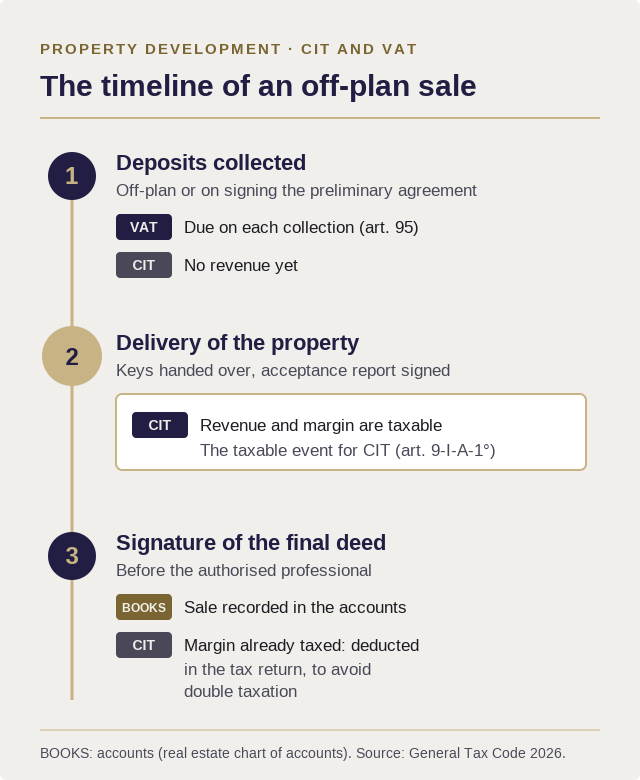
| Event | What happens | Legal basis |
|---|---|---|
| Collection of a deposit, an instalment or the balance | VAT is due on the amount collected | Tax Code, art. 95 |
| Delivery of the property to the buyer | Revenue and margin are taxable under CIT | Tax Code, art. 9-I-A-1° |
| Signature of the final deed | The sale is recorded in the accounts | Real estate chart of accounts |
In most projects, these three dates do not fall in the same year. That is where mistakes arise.
What the General Tax Code provides
Taxable revenue is linked to delivery. Article 9-I-A-1° of the Tax Code includes receipts and receivables earned “relating to products delivered”. The text mentions neither the authentic deed nor collection of the price.
The tax rule prevails over the accounting rule. Article 8-I starts from the accounting profit, but adjusts it where tax law provides otherwise. The developer keeps its books under the sector chart of accounts, then adjusts its profit in the tax return.
Undelivered property stays in inventory. A completed flat not yet handed over to the buyer is carried in inventory at cost (articles 8-I and 9-I-A-2°). It does not yet generate any taxable margin.
VAT follows collection. Property development is subject to VAT on a mandatory basis (article 89-I-4°). VAT is due on full or partial collection of the price (article 95), unless the developer has opted for the invoicing (accrual) basis. The taxable base is the sale price less the indexed cost of the land (article 96-4°).
For more on VAT, see our article on VAT in Morocco in 2026.
The DGI’s position: delivery prevails
By letter of 6 January 2026, a taxpayer writing on behalf of several development companies asked the DGI for guidance. Under the new chart of accounts, the sale is only recorded at the final deed, whereas it used to be recorded on full collection of the price. This creates a gap between collection, accounting revenue and taxation of the margin. The taxpayer asked whether full collection of the price counted as revenue, even without a contract, and whether the related margin was subject to CIT.
In its reply of 21 January 2026 (letter no. D 42/26/DGI), the DGI refers to articles 8-I and 9-I-A of the Tax Code and to the earned-receivable principle. It concludes that the taxable event for the sale of real estate is the delivery of the buildings sold, regardless of the date on which the price is collected and of the date on which the final deed is signed.
Delivery is not transfer of ownership. Delivery is the moment the seller parts with the property and allows the buyer to take possession without hindrance (article 499 of the Code of Obligations and Contracts). Ownership may pass later, at the deed. Circular note no. 717 already distinguishes the two.
Scope of the reply. This is a clarification sent to a specific taxpayer, not a circular. Its reasoning, however, rests on the text of the Tax Code and on circular note no. 717, which allocates sales to the financial year of delivery. It therefore applies to any developer subject to CIT.
How to prove the delivery date
The delivery date determines the tax year. It must be provable in a tax audit. Where delivery takes place before the final deed, the DGI states that it is evidenced “in particular” by:
- the handover of the keys or plans to the buyer,
- together with a preliminary sale agreement,
- and supported by an acceptance report signed by the buyer.
These documents work together: gather all three for each unit.
In practice, date and keep an acceptance report for every unit delivered, and reconcile it each year with the list of sales recorded in the accounts.
Worked example
A development company subject to CIT sells one flat for MAD 1,000,000 excluding VAT. Its cost (land and construction) is MAD 700,000, a margin of MAD 300,000. The flat is delivered in 2026 (keys handed over, acceptance report signed), but the final deed is only signed in 2027. Simplified example: no other expenses or income.
| 2026: delivery | 2027: final deed | |
|---|---|---|
| Revenue in the accounts | 0 (the flat stays in inventory at MAD 700,000) | MAD 1,000,000 |
| Accounting profit | 0 | MAD 300,000 |
| Adjustment in the tax return | + MAD 300,000 (margin on the delivered property) | − MAD 300,000 (margin already taxed) |
| Taxable profit | MAD 300,000 | 0 |
| CIT at 20% | MAD 60,000 | 0 |
Key takeaway. Without the adjustment, the company would report nil profit for 2026 and risk a reassessment for that year. In 2027, the deduction prevents the same margin from being taxed twice. The total tax does not change (MAD 60,000): only the tax year is at stake.
If the flat is only delivered in 2027, the same year as the deed, it stays in inventory at cost at the end of 2026: no margin is taxed in 2026, and the MAD 300,000 is taxed in 2027 with no adjustment.
The minimum tax is still due every year. In 2026, 0.25% of MAD 1,000,000 gives MAD 2,500, raised to the legal minimum of MAD 3,000. As CIT (MAD 60,000) is higher, CIT is what the company pays. For 2027, no text says whether revenue recorded at the deed, already taxed in 2026, falls within the minimum tax base: only the MAD 3,000 minimum is certain (article 144-I-D).
These adjustments are made in the reconciliation from accounting profit to taxable profit. For rates and deadlines, see corporate income tax in Morocco in 2026.
Deposits collected off-plan
Amounts received before delivery follow two different regimes:
- For CIT, they are not yet revenue. They are recorded as deferred income until the property is delivered.
- For VAT, they are taxable as soon as they are collected, whether a deposit, an instalment or the balance (article 95).
One exception: earnest money kept by the developer when the buyer withdraws from the sale is compensation for damages, not subject to VAT.
Open questions
The DGI’s reply does not settle everything. There is still no official position on:
- cases where the final deed is signed before delivery;
- the transition years 2024 and 2025;
- sales subject to a condition precedent, which defer the sale until the condition is met;
- individual developers, who are subject to personal income tax rather than CIT.
On these points, a case-by-case analysis is needed before filing the return.
Summary
- For CIT, the sale of a home is taxed in the year of delivery.
- VAT is due on each collection, deposits included.
- The final deed sets the accounting date, not the tax date: the gap is corrected in the tax return.
- Keep evidence of delivery: signed acceptance report, key handover, preliminary sale agreement.
Ascensu supports property developers with their tax returns and with the reconciliation from accounting profit to taxable profit, project by project.
Need help applying these rules to your business? Explore our Tax returns.
Official sources
- General Tax Code 2026, art. 8, 9, 19, 95, 96 and 144
- DGI circular note no. 717 (2011), volume 1 (taxable profit) and volume 2 (VAT)
- DGI letter no. D 42/26/DGI of 21 January 2026 (clarification sent to a taxpayer)
- Code of Obligations and Contracts, art. 499 (delivery of the thing sold)
This article is provided for general information, as at its publication date. It is not personalised advice: the rules change and every situation must be reviewed on its own facts.